
Patent Search (Basic)
Upload your invention description and see the earlier patents and publications an examiner could cite against it, with citations checked against the source records.
Turnaround: usually within one hour; sometimes up to 24 hours. Pay per search, no subscription.
Who it is for
- Independent inventors deciding whether an idea is worth a patent attorney's time
- Startup founders checking novelty before building around a feature
- Product designers and engineers who want a quick prior-art look before an invention disclosure
- Hardware makers and makers' groups testing several ideas cheaply
- Anyone preparing to talk to a patent attorney who wants to arrive informed
What it does
You upload a description of the invention. Primoris searches patents and publications, narrows to the closest references, and compares the top ones element by element to your invention. The question it answers is patentability only: is the invention new and non-obvious compared with the prior art found. It does not answer whether you may make or sell anything.
Key capabilities
- US patents 1976 to present, searched on title, abstract and first claim, narrowed by CPC class and re-ranked by meaning
- Foreign and PCT patent documents through the European Patent Office (bibliographic data: title, abstract, CPC)
- Published US patent applications and scholarly literature (titles and abstracts)
- Up to about 15 closest references, with a claim-1 element comparison for the top 3 to 5
- Every cited patent checked against the source records; unverifiable items are dropped
How it works
- Create an account and open Patent Search (Basic). You see the price, turnaround and limits before you pay.
- Upload a description of your invention (PDF, DOCX or TXT), or paste the text.
- Pay for the search by card, or apply a voucher.
- Primoris runs keyword queries over US patents, narrows by CPC class and re-ranks by meaning. It also searches published applications, scholarly literature, foreign and PCT documents, and a small sample of web pages.
- The closest references are compared element by element to your invention.
- Primoris verifies the citations against the source records and drops anything it cannot verify.
- Your report is ready usually within one hour, sometimes up to 24 hours. You get an email, and the report (web view and PDF) is in your account.
What we search
Each report also states, in its Search Scope and Limitations section, the date each source is current through. See Sources for all products.
| Source | What it covers | Data current through / refresh | Limits |
|---|---|---|---|
| US granted patents | US patents 1976 to present, with CPC classes; title, abstract and first claim searched | Loaded from USPTO releases; each report states the date it is current through | Later claims and the full description are not searched. Patents granted before 1976 are not searched |
| Published US applications | Published applications via the USPTO Open Data Portal (titles and bibliographic data) | Searched live on the report date | Titles and bibliographic metadata only. Unpublished applications (typically the first 18 months) cannot be seen |
| Foreign and PCT patents (EPO) | EP, WO/PCT and other national-office documents in the EPO Open Patent Services (DOCDB/INPADOC); title, abstract, applicants, dates and CPC codes | Searched live on the report date | Abstract level only: no claims, no descriptions, no machine translation. Many national offices and records without an abstract are not covered |
| Scholarly literature | Papers indexed by the literature sources used in the report (titles and abstracts) | Searched live on the report date | Literature outside those sources is not searched. The report lists which sources answered |
| Web check | A small sample of web pages for products and public use | Searched live on the report date | Labelled unverified. Not a complete search of products or public use |
What you get
A report in three parts, as a web page in your account and a PDF you can download, with an email when it is ready.
Part A: Summary
One page, plain English
- Risk Factor Rating (High, Medium or Low) with a one-sentence meaning
- A verdict in plain English, framed as "prior art we found that an examiner could cite"
- Top matches table: reference, title, owner, date, why it matters, closeness
- Points to discuss with an attorney
Part B: Technical detail
For attorneys and careful readers
- Your invention as we understood it
- Closest references in detail, with a claim-1 element comparison for the top 3 to 5
- Other sources: published applications, literature, foreign/PCT, web (labelled unverified)
- Assessment: what drives the rating and what would lower it
- Automated design-around ideas to discuss with an attorney
Part C: Appendix
Method, full tables, limits
- Full reference tables
- Queries executed (summarised) and method
- Search Scope and Limitations, with the data-currency date
- Disclaimer
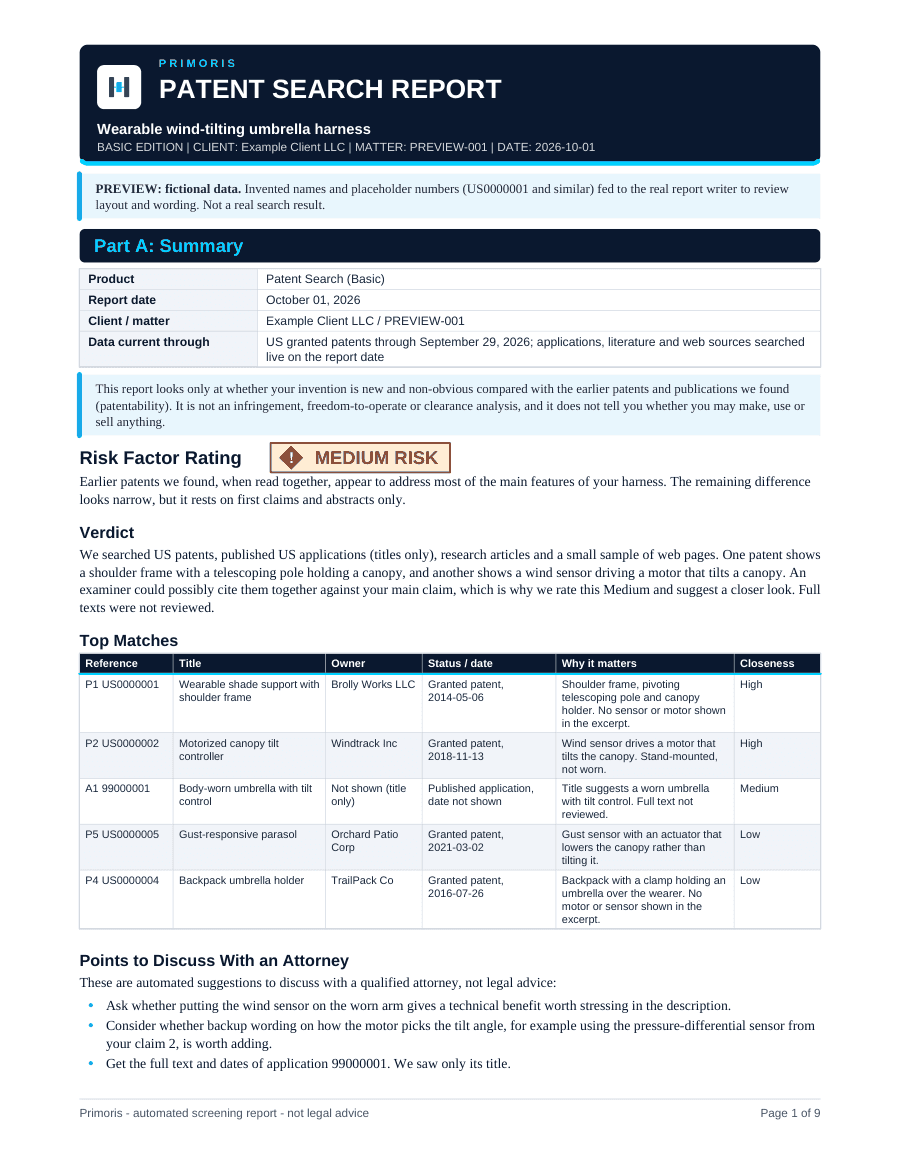
First page of a sample report
The data in samples is fictional. Real reports follow the same layout.
See all sample reportsWhat you provide
- Invention description
- A PDF, DOCX or TXT file up to 25 MB, or pasted text of at least 200 characters. A draft or disclosure is fine.
- Optional notes
- The features you think are new, so the comparison can focus on them.
Uploaded files are deleted once the report is complete.
What it does not cover
- Infringement, freedom-to-operate or clearance. It does not tell you whether you may make, use or sell anything
- Unpublished applications (typically the first 18 months before publication)
- Later claims and full descriptions of US patents; claims and descriptions of foreign patents
- Patent offices not reachable through the EPO, and foreign-language text translation
- Products, websites and public use outside the sources listed
- Legal advice, or an attorney opinion on patentability, or any guarantee a patent will be granted
Risk rating explained
Every report opens with a Risk Factor Rating. The words, not the colour, carry the meaning. The rating is a screening aid, not a legal finding.
- HIGH RISK
- Very close prior art was found. An examiner could possibly cite the references together against your main claim.
- MEDIUM RISK
- Related prior art was found, but with meaningful differences. The remaining difference may be narrow, and the screen rests on first claims and abstracts.
- LOW RISK
- No close prior art was found in the sources searched. Absence of results is not proof of novelty.
Pricing and payment
$99.99 per search. You pay for each search you run.
- No subscription, no recurring charges and no prepaid credits. There are no upgrades between products.
- You need an account before you buy, and you see the price and the limits before you pay.
- Purchases are non-refundable once the search has started, including if you are unhappy with what the report found. If we fail to deliver a report, you are refunded in full.
- If you have a voucher, enter it at checkout.
See the Refund Policy, the Terms of Service and Pricing.
Frequently asked
- Is this a freedom-to-operate or infringement search?
- No. The report looks only at patentability: whether your invention appears new and non-obvious compared with the earlier patents and publications we found. It does not say whether you may make, use or sell your invention.
- Which patents are searched?
- US patents from 1976 to present, published US applications, scholarly literature, and foreign and PCT documents available through the European Patent Office at abstract level. See the data sources table above for the limits of each.
- Can the search miss something?
- Yes. Unpublished applications, products and public use outside the sources, and anything beyond first claims and abstracts can be missed. A gap in the results does not mean nothing exists.
- Are the citations real?
- Citations come only from search results, never from the AI model's memory, and each cited patent is checked against the source records.
- What file can I upload?
- PDF, DOCX or TXT up to 25 MB, or paste the text (at least 200 characters). Your uploaded files are deleted once the report completes.
- What is different in Patent Search (Advanced)?
- Advanced is coming soon. It is planned to chart every claim and cover more references and international sources. See its page for the planned scope.
More answers on the FAQ page.
Related products
Patent Search (Advanced)
$249.99per search
Deeper patent screening with international coverage. Coming soon.
Learn more about Patent Search (Advanced)
Available nowDesign Search
$99.99per search
Upload drawings of your design and compare them with US design patents.
Learn more about Design Search
Available nowTrademark Search (Basic)
$99.99per search
Screen a name against US federal trademark records, including similar spelling and sound.
Learn more about Trademark Search (Basic)
Ready to run Patent Search (Basic)?
Create an account, enter your details and get your report, usually within one hour.
Primoris reports are automated screening reports. They are not legal advice and not an attorney opinion, and no attorney-client relationship is created. A gap in the results does not prove that nothing exists. Talk to a registered patent or trademark attorney before filing or relying on a report.